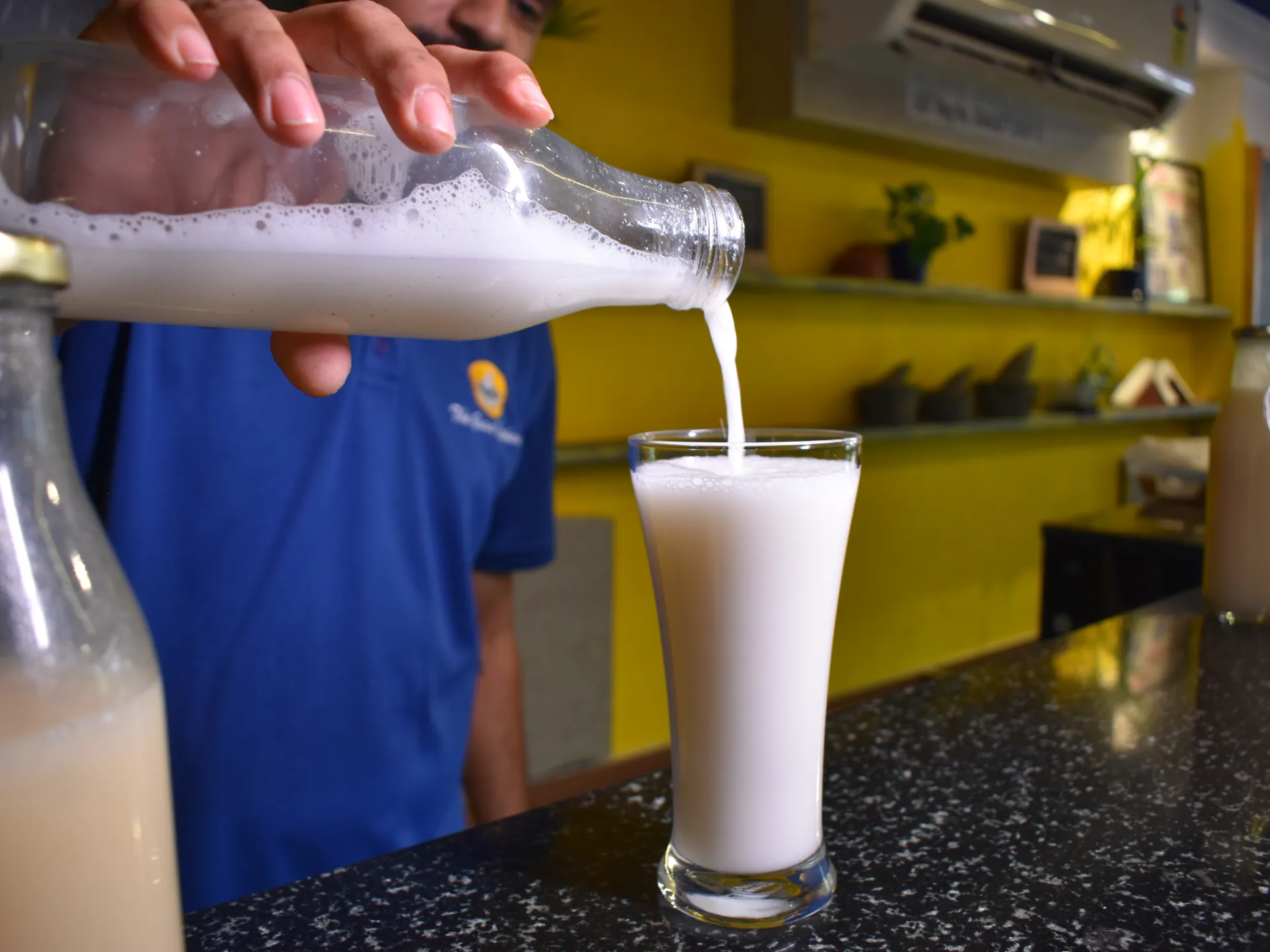
Once reserved for elite Catholic households, this almond drink survives thanks to Goans preserving tradition.
Goa, India – “Drink before the ice melts,” says Eunice Lima Fernandes De Sa, almost sternly, as she places three tall glasses of a pale, milky liquid onto a lace-covered table at her home in Ribandar, a village on the banks of the Mandovi River, a few kilometres from Panaji, Goa's capital.
Settling into her verandah overlooking the river below, I lift my glass. The first icy sip sends a sharp ache across my forehead, forcing me to pause. An almond richness coats my tongue before giving way to a mild sweetness.
Ahead, a small garden slopes away from the house. There, her three-year-old grandson clutches a plastic bottle filled with the same cloudy white drink. Every few seconds, he pauses to take another sip before glancing curiously in our direction.
"This is my orchata!" he sings out, waving the bottle at us.
To him, it is simply a favourite drink. For many Goans, however, the orchata has faded from everyday memory; others have never even heard of it.
But for those who remember it, it carries family histories, celebrations and summers that stretch back generations.
As a Goan myself, though raised in Mumbai, a city 600km (370 miles) away, I had never heard of it before. I stumbled upon the drink almost by accident when a friend shared a video circulating among the Goan diaspora.
On screen, Eunice narrated how she had recreated orchata decades after it disappeared from her life. With no recipe in hand, she relied on a vague memory of its taste from summers long ago.
My friend, who spent her childhood in Goa, grew up drinking orchata at her boarding school, where nuns prepared it on feast days. After she moved to Mumbai for work in her early 20s, the drink was gradually lost to time. The video brought back a part of her life she had almost forgotten.
Later that evening, I scrolled through the comments on the video. They revealed the same pattern. Most memories were tied to weddings, feast days, and family celebrations.
“I remember tasting orchata at a neighbour’s wedding—he was a doctor. A randpinn [a local cook] from the village used to prepare it,” wrote a woman in her 70s from Betalbatim, a village in South Goa.
“Coelho’s orchata was the best,” another wrote, recalling the family-run establishment that once produced and sold the drink before shutting down in the 1990s.
Traditionally, orchata is sweet, made entirely from almonds and sugar. The nuts are soaked, peeled, and ground into a thick white paste. The paste is then cooked down with sugar and passed through a muslin cloth until smooth and pulpy, with minimal graininess. Some recipes add rose water, cardamom, or almond essence.
To consume, the concentrate is diluted with water to a milky consistency and poured over ice.
It was made by “those” families, I am repeatedly told — a reference to upper-caste, Portuguese-speaking, Catholic households that maintained close ties with the Portuguese in colonial Goa. In their sprawling homes, they hosted ballroom dances, with glass showcases displaying imported crystal and crockery.
From their kitchens emerged a distinct Luso-Goan culinary heritage that still occupies an uneasy space between aspiration and inheritance. Orchata is one such drink.
Even its ingredients signified status: almonds had to be imported and, in tropical Goa, ice itself was once considered a luxury.
For those who did not make it at home, especially in post-colonial Goa, the Coelhos produced it commercially, becoming almost synonymous with orchata. People offer different explanations for why the business closed. Some say a family member central to production died. Others believe orchata lost ground to bottled soft drinks and gradually fell out of favour.
For many families, the disappearance of Coelho's orchata happened gradually rather than all at once.
“Bottles slowly began disappearing from the shelves of the stores we bought orchata from,” Eunice recalls. “There were fewer and fewer bottles available. And then, one day, there were no bottles left. After that, it was never restocked.”
In recent years, however, a handful of individuals and businesses have quietly begun making orchata, often in small batches and by pre-order.
My search for orchata’s roots takes me to Margao in South Goa, where traffic-heavy streets give way, unexpectedly, to pastel-hued homes and Portuguese-influenced mansions.
In Margao, Goa's commercial hub in the south of the state, Carol Baretto Miranda, a French professor at Goa University, welcomes me into her deep-red family home. In the living room, she unwraps a yellowing book from layers of newspaper before placing it carefully in my hands.
"If my house were to catch fire," she says without hesitation, "this is the first thing I would save."
The cookbook is a family heirloom: a well-worn copy of The Goan Cookbook by Joyce Fernandes, first published in the 1980s. Its spine is barely held together with rusty pins and brown tape, the pages softened by decades of use.
Carol tells me her mother-in-law cooked from it so often she almost knew it by heart. She made what Carol still remembers as the best orchata she had ever tasted.
Among its recipes for bebinca, a layered Goan dessert, and cafreal, a spiced chicken dish, sits a modest recipe for orchata. A few lines occupy less than half a page, preserving the drink I had come searching for.
“The roots of orchata as such date back to the 13th century,” says Oliver Fernandes. “It originated in Moorish culture and travelled to Hispania, where it was known as Horchata, made with tiger nut.”
For Oliver, however, orchata is more than a curiosity of culinary history. As cofounder of The Goan Kitchen, he sees it as part of a wider effort to preserve lesser-known Goan foods and drinks before they disappear altogether.
The Goan Kitchen sits on a quiet street in Margao, not far from the Holy Spirit Church. Against its yellow walls, shelves are lined with pickles, chutneys and spice blends. Glass counters display Goan sweets and snacks, while a modest counter serves traditional meals from a changing daily menu.
Oliver grew up in a family where food marked every milestone and celebration. After studying hotel management and spending two decades in the corporate world, he cofounded The Goan Kitchen with Crescy Baptista, his longtime friend and business partner.
Crescy had run a home catering business from Loutolim, a village in South Goa, and learned more than 200 dishes from her mother-in-law, Dona Elisa Baptista, like the art of selecting the right ingredients and perfecting the tricks that rarely make it into written recipes.
Together, Oliver and Crescy wanted to create a space for foods that had slipped out of restaurants and bakeries: dishes found in a neighbour's kitchen, or in a handwritten recipe book.
Their mission, Oliver says, is “to be the custodian and repository of Goan food culture”. Orchata appears on their pre-order menu, among more than 250 dishes, many of them lesser-known or slowly disappearing.
“From Spain, the horchata travelled to South America, where it was made with cashew, rice, tiger nut or even peanut, each country developing its own version. Through Portugal’s colonisation of Goa, the drink eventually arrived here, and was christened 'orchata',” Oliver says, as mando music plays softly in the background.
Goa largely retained almonds, despite the abundance of local cashews, because the imported nuts carried status. Keeping almonds in the recipe reinforced the drink's association with wealth and Portuguese-influenced Catholic households, Oliver says.
He believes that in the years leading to the liberation of Goa from the Portuguese colonisers in 1961, political dissent prompted the latter to supply exotic dry fruit at subsidised rates to families they hoped would remain loyal.
The orchata at The Goan Kitchen is Crescy’s family recipe. “We’ve only fine-tuned the sugar,” he adds, “So it isn’t overly sweet, but balanced enough for preservation.”
Back in Ribandar, Eunice moves slowly through her garden, brushing dried leaves from a kokum plant. At the mention of orchata, her wrinkled face breaks into a smile.
“I first drank orchata in my early teens; it was a family favourite,” she recalls.
It wasn’t made at her home. Her family would source bottles prepared by the Coelhos from a handful of shops in Panaji: Cappuccina Bar and Restaurant, Farm Products and Lija Camotim.
“We would especially buy it during summer, and drink it with lots of ice.”
One particularly difficult summer, after giving birth to her first child, she remembers surviving almost entirely on orchata. Years later, her daughter-in-law would find herself doing the same.
“It had been almost 30 years since it was last available,” she says. “I was craving its sweet, almondy flavour and decided to try making it myself.”
What followed was years of trial and error. “I tried different proportions, and after five to seven summers, I finally got it right,” she says, beaming. She laughs at the memory. She simply wanted to taste the orchata she remembered growing up.
During the COVID-19 pandemic, demand grew unexpectedly, turning it into a small, pre-order-based business.
Eunice uses a mix of almonds and cashews to prepare her concentrate. The cashews, she says, lend it a creamier texture. She blends the concentrate with equal parts milk before diluting it with water for a silkier consistency.
Guilhermina Vas, Eunice's friend and former colleague, grew up in Panjim's Altinho neighbourhood. Small-framed and animated, she jumps into the conversation before Eunice has finished speaking, eager to offer another memory.
Her gold-rimmed glasses slide to the edge of her nose as she laughs. "Orchata isn't for everyone. In my house, I was the only one who liked it."
Her neighbour, Dona Zenia, who lived two houses away, celebrated her own birthday every year with homemade orchata.
"I used to look forward to that day just for the orchata," she laughs. "My sisters, however, didn't care for it much."
“Ice makes all the difference,” they both insist.
I ask Eunice what drinking orchata feels like after all these years, what memory it stirs.
“It makes me happy,” she says simply.
“Doesn’t it remind you of your mother?” Guilhermina asks.
Eunice fiddles with the base of her glass. Her smile softens, and for a moment her eyes glisten.
"I immediately think of my mother, returning home in the afternoons after playing, asking her for a glass of orchata," she says.
Her mother, she says, would take a bottle she had stored in the family’s icebox and prepare a glass for her.
“It reminds me of simple, happy times in the home I grew up in at Chorao, just across the river.
“When people drink it, they often close their eyes. It transports them back to childhood, or to a period 20 or 30 years ago, when a grandmother or an aunt would make it,” says Oliver. “It feels deeply personal, attached to a memory, to a person, or to a moment.”
When people drink it, they often close their eyes. It transports them back to childhood by OLIVER FERNANDES, THE GOAN KITCHEN
When people drink it, they often close their eyes. It transports them back to childhood
by OLIVER FERNANDES, THE GOAN KITCHEN
Sitting on Eunice’s verandah, it becomes clear that orchata survives because of the people who remember making it, serving it and drinking it together. The recipes can be recreated. The worlds they belonged to cannot.
The older generation that held on to these recipes has passed on, while the younger generations who inherited them moved away from Goa in search of better economic prospects.
The social lines that once determined who could access certain ingredients have also shifted. Ingredients that once signified privilege became more accessible, and the exclusivity gradually lost its allure.
The Goa that produced those orchatas has changed, too. Overtourism and rapid development have replaced fields with resorts and apartment blocks, altered coastal skylines and reshaped once-quiet villages.
At the river, a speedboat whirs past. Ribandar, with its pastel-hued homes and winding roads, is slowly changing. Yellow-plated tourist taxis stream through its narrow streets. Old houses stand abandoned or give way to apartment blocks. And Orchata, itself, has largely disappeared from family tables, too.
The drink’s history is more layered than nostalgia alone. In India, food often carries the weight of caste, and orchata is no exception. The ingredients, the occasions when it was served, and the households associated with it all signified privilege, wealth, and colonial connections.
"There's no other drink here that comes under so much scrutiny," says Oliver. "If it wasn't served, no one noticed. But if it was, people paid attention and asked: Who made it?"
“It was not a common man’s drink,” I’m repeatedly told.
Everyone I spoke to associated it with upper-caste Catholic households. There was always ‘that aunt’, supervising its production, deciding when it was to be served, and safeguarding the recipe. It remained associated with a handful of families, disappearing with the person who carried it.
Those outside these circles were likely to encounter it at a feast or a wedding. Some, like my friend, remember it through the nuns at school. Others through the Coelhos.
Even so, the drink remained absent from many Goan households, including Goan Hindu homes.
Oliver himself encountered the drink only occasionally as a child, at select functions in select households. His own family did not prepare it at home, and he came to understand its deeper cultural nuances much later.
There is also a revealing juxtaposition. In Goa, cashews are abundant and deeply woven into regional cuisine. Marzipan, traditionally made with almonds elsewhere, is often prepared with cashews here. Yet orchata continued to be made from almonds.
It was a drink that a particular section of society adopted and made their own.
The conversations leave me thinking less about revival than preservation. Orchata was never a drink enjoyed across all of Goa. Today, a handful of people are simply trying to ensure it isn't forgotten.
Orchata's future is unlikely to resemble its past. Rather than returning to elite family tables, it survives because a handful of people continue to make it, share it and introduce it to new drinkers. That wider accessibility inevitably changes the drink's meaning, but it may also be the only way it endures.
Back in Margao, Marcaflys, a brand specialising in Goan spice mixtures, pickles and jams, also produces orchata. Founded in 1971 by Maria and Carmo Souza, it is now run by their son, Joaquim Souza.
Maria Souza, 82, has been making orchata since the 1960s, for occasions and family and friends. Marcaflys, however, only recently began producing it commercially, and still only in small batches.
Bottles of the concentrate are sold in supermarkets across Goa during the peak summer months of April and May. According to Joaquim, Marcaflys is the only licensed manufacturer of the drink today.
“My parents are among the oldest people still making it,” Joaquim says.
But demand remains limited. In a crowded market, orchata survives through familiarity. It is rarely an impulse purchase. The people who buy it are those who already know of it or carry a memory of it.
“It is generally a small group of customers who buy it; sales in tourist-heavy areas are poor,” Joaquim adds. “It’s nice to say you manufacture it, but the sales are quite average.”
Joaquim does not expect orchata ever to become a mainstream drink again. For him, continuing to produce it is as much about preserving a small part of Goa's food heritage as growing a business.
Orchata has appeared on wedding menus, but it is usually passed over in favour of more familiar drinks. A handful of tourists from Portugal have enjoyed it enough to ask for bottles to take home. Within Goa, however, demand remains modest.
For Eunice, a steady demand from loyal family and close friends keeps her going.
At The Goan Kitchen, Oliver attempts to introduce the drink to a wider audience. “It’s often the first thing we recommend to tourists looking to try something new,” he says. “We also supply it to bars, where it is used in cocktails.”
"There is always an X-factor associated with nostalgia," Oliver tells me. Some customers love the orchata. Others insist it is not the same as the one they remember from decades ago.
Oliver tells me nostalgia is difficult to recreate.
Orchata may never again occupy the place it once did in Goa. The homes that served it have changed, and so has the society that shaped it.
Yet every summer, Eunice still soaks almonds, grinds them into a paste and bottles the concentrate for friends, family and the handful of strangers who come looking for a taste they remember.
That may not be a comeback. But it is enough to keep a small piece of Goa's culinary history from disappearing altogether.
Source: https://www.aljazeera.com/features/longform/2026/7/17/goas-forgotten-orchata-drink-lives-on-in-family-kitchens?traffic_source=rss